

Endometriosis impacts nearly 10% of women of reproductive age, yet the journey to diagnosis often spans 7–11 years, largely due to the reliance on surgical laparoscopy. Embracing non-surgical diagnostic avenues offers quicker answers, minimizes invasive risks, and empowers individuals to start managing their symptoms sooner. This article delves into the initial indicators of endometriosis, assesses the precision of high-resolution ultrasound and MRI, explores emerging blood and urine markers, outlines clinical diagnostic approaches, reviews non-surgical treatment options, and illustrates how these methods shorten the diagnostic timeline. It also highlights how a specialized center like EndoExcellenceCenter.com integrates advanced imaging and expert clinical evaluation into personalized care plans.
What Are the Common Symptoms and Early Signs of Endometriosis?

Endometriosis is a chronic inflammatory condition where tissue similar to the uterine lining grows outside the uterus, leading to pain and functional disturbances. Identifying the earliest warning signs facilitates earlier clinical evaluation and imaging, which can confirm a likely diagnosis without immediate surgery. Recognizing these manifestations paves the way for targeted non-invasive assessments and quicker access to care, setting the stage for effective treatment strategies.
Which Symptoms Indicate Possible Endometriosis Beyond Painful Periods?
Several symptoms extend beyond painful periods and guide non-surgical evaluation:
- Persistent pelvic pain that worsens around menstruation and may extend to the back or thighs
- Pain during intercourse (dyspareunia) stemming from lesions along the uterosacral ligaments or cul-de-sac
- Bowel or bladder discomfort, including painful urination or bowel movements associated with infiltrative lesions
- Challenges with fertility or subfertility, where endometrial implants may affect ovulation or tubal function
These indicators prompt clinicians to consider imaging and laboratory tests, bypassing the need for surgical confirmation, which naturally leads us to discuss diagnostic delays and patient advocacy.
How Does Diagnostic Delay Affect Endometriosis Detection?
Delayed diagnosis exacerbates the impact on quality of life, prolonging pain, affecting mental well-being, and potentially hindering fertility.
A comprehensive review and meta-analysis on diagnostic delays in endometriosis revealed that the time to diagnosis can range from 4.4 years to over 10 years across various studies. (pmc.ncbi.nlm.nih.gov)
When definitive laparoscopy is postponed, individuals may face repeated misdiagnoses or ineffective treatments. Non-surgical pathways—such as structured symptom tracking, pelvic examinations, and targeted imaging—circumvent lengthy surgical wait times and reduce the risk of advanced lesion development. Shortening the evaluation period minimizes lesion progression and supports more prompt symptom relief, underscoring the value of clinical assessment. We cover this further in Assess Your Endometriosis: When to Consider Advanced Surgery.
What Is the Role of Clinical Assessment in Non-Surgical Diagnosis?
Clinical assessment integrates a patient’s medical history, a thorough pelvic examination, and standardized symptom tracking to establish a working diagnosis. During a pelvic exam, a specialist can identify tender nodules along the uterosacral ligaments and assess limitations in organ mobility, providing evidence of deep infiltrating disease. Symptom diaries and pain scales quantify patterns that strongly correlate with imaging findings. This structured approach, employed at centers like EndoExcellenceCenter.com, expedites decisions regarding appropriate non-invasive tests, seamlessly transitioning the diagnostic process to advanced imaging evaluation.
How Effective Is Ultrasound for Diagnosing Endometriosis Without Surgery?
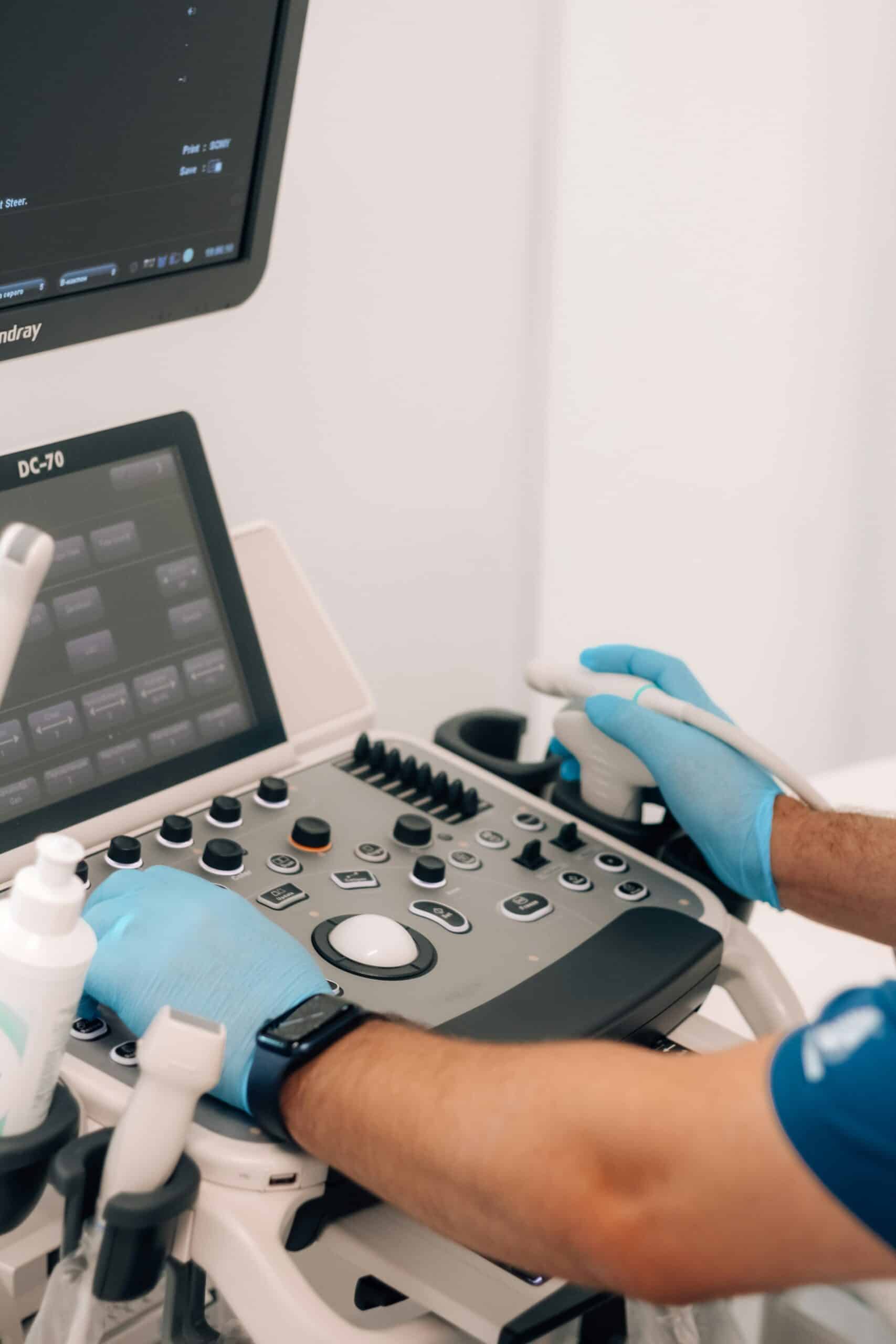
Transvaginal and pelvic ultrasound serve as primary, non-invasive imaging methods for visualizing endometriosis-related changes. High-resolution ultrasound utilizes sound waves to detect ovarian endometriomas, nodules, and tissue adhesions, allowing clinicians to identify lesions with 80–90% sensitivity for endometriomas. As a readily accessible investigation, ultrasound supports early decision-making and can guide further MRI assessment when deeper infiltration is suspected, establishing its crucial role in non-surgical diagnosis.
What Can High-Resolution Transvaginal Ultrasound Detect in Endometriosis?
High-resolution transvaginal ultrasound reliably identifies:
- Ovarian endometriomas (chocolate cysts), appearing as uniform, low-level echogenic masses
- Deep infiltrating endometriosis (DIE) in the rectovaginal septum, uterosacral ligaments, and bladder wall
- Adhesions causing restricted organ movement or the “kissing ovaries” sign
- Adenomyosis, visualized through myometrial cysts and a thickened junctional zone
By pinpointing these findings, ultrasound guides targeted MRI scans and informs clinical treatment planning before considering laparoscopy for confirmation or removal.
What Are the Limitations of Ultrasound in Endometriosis Diagnosis?
While valuable, ultrasound has certain limitations:
- Superficial peritoneal lesions often fall below resolution thresholds and may go undetected.
- Operator dependency leads to variable sensitivity based on the examiner’s skill.
- Body habitus and bowel interference can obscure pelvic views, reducing accuracy.
- Inability to assess certain adhesions that require MRI’s superior soft-tissue contrast for detailed mapping.
Understanding these constraints highlights when to complement ultrasound with MRI, thereby enhancing diagnostic precision.
How Should Patients Prepare for an Endometriosis Ultrasound?
- Empty your bladder before transvaginal scans to improve probe contact and image clarity.
- Undertake mild bowel preparation (e.g., a gentle laxative) if advised, to minimize gas artifacts.
- Maintain consistent symptom diary entries leading up to the imaging to correlate pain peaks with findings.
- Wear comfortable clothing for ease of access and smooth transitions between abdominal and transvaginal imaging.
Such preparation optimizes lesion visualization and guides subsequent MRI planning, which we will explore next.
Can MRI Accurately Diagnose Endometriosis Without Laparoscopy?
Magnetic resonance imaging (MRI) utilizes magnetic fields and radiofrequency pulses to generate high-contrast images of pelvic structures, making it ideal for mapping deep infiltrating endometriosis and adhesions. As a non-invasive diagnostic tool, MRI achieves over 90% specificity for DIE and provides three-dimensional lesion localization that informs non-surgical treatment strategies. For more detail, see our article Surgical vs Non-Surgical Endometriosis Treatment Options.
These capabilities position MRI as an indispensable complement to ultrasound within a comprehensive non-surgical diagnostic pathway.
How Does MRI Detect Deep Infiltrating Endometriosis and Adhesions?
MRI identifies deep infiltrating endometriosis by:
- Highlighting hypointense fibrotic tissue against hyperintense fluid in T2-weighted sequences
- Visualizing adhesions as connecting bands between organs, altering normal anatomical relationships
- Detecting endometriomas through high T1 signal and fat-suppression techniques that confirm the presence of blood products
- Revealing rectosigmoid and bladder wall involvement via multiplanar imaging
These detailed anatomical maps support personalized, non-surgical management and may eliminate the need for immediate laparoscopy in many instances. Read more in Safe and Effective Non-Surgical Treatments for Endometriosis.
What Are the Advantages and Limitations of MRI Compared to Ultrasound?
This comparison highlights how MRI addresses the limitations of ultrasound, and how both modalities together can reduce the necessity for diagnostic laparoscopy, leading to clearer treatment pathways.
When Is MRI Recommended in the Non-Surgical Diagnostic Pathway?
- When ultrasound findings are inconclusive for suspected DIE or multiple endometriomas.
- When deep infiltrating lesions are suspected in the bowel or urinary tracts, requiring detailed mapping.
- When complex pelvic anatomy or adhesions hinder ultrasound visualization.
- When guidance for surgical planning is needed, but non-invasive staging is sufficient.
Integrating MRI at these critical decision points maximizes diagnostic accuracy and minimizes unnecessary surgical interventions, guiding us toward biomarker research next.
Are There Blood Tests or Biomarkers That Can Diagnose Endometriosis Non-Invasively?

Ongoing scientific research is focused on identifying reliable biomarkers in blood, urine, or saliva that can indicate the presence of endometriosis without the need for imaging or surgery. While CA-125 has been extensively studied, its limited specificity necessitates its use within multi-marker panels. Emerging microRNAs and protein signatures show considerable promise, though clinical validation is still in progress. Validating these biomarkers could revolutionize early non-surgical detection and integrate seamlessly into patient screening protocols.
What Is the Current Status of Blood Biomarkers Like CA-125 for Endometriosis?
CA-125, a glycoprotein that can be elevated in cases of pelvic inflammation, serves as an adjunctive indicator: Read more in Hysterectomy Insights for Endometriosis Sufferers.
- Elevated CA-125 levels are often associated with moderate to severe endometriosis.
- The sensitivity of this single marker ranges from 50–80 percent, with specificity between 50–70 percent.
- Levels can overlap with other conditions, such as ovarian cysts or pelvic inflammatory disease.
Given these limitations, CA-125 aids in risk assessment but does not replace imaging, underscoring the need for more precise diagnostic panels.
How Promising Are Urinary and Salivary Biomarkers in Endometriosis Diagnosis?
Alternative bodily fluids offer non-invasive sampling possibilities:
- Urinary markers, including distinct microRNA profiles and peptides, have demonstrated approximately 85% accuracy in initial studies.
- Salivary cytokine patterns reflect systemic inflammation linked to endometrial implants.
- Metabolomic signatures found in urine and saliva indicate dysregulated biochemical pathways.
While these methods show promise, they require standardized assays and extensive validation through large-scale studies before widespread clinical adoption, leading us to the challenges of translating biomarker research.
How Is Clinical Diagnosis of Endometriosis Made Without Surgery?
Clinical diagnosis involves synthesizing symptoms, physical findings, and non-invasive test results to arrive at a probable endometriosis diagnosis. Current guidelines from European and U.K. bodies endorse clinical diagnosis supported by imaging when laparoscopy is not immediately feasible or necessary. This approach accelerates treatment initiation and reduces psychological distress, affirming the critical role of expert clinicians in managing endometriosis without defaulting to surgery.
What Do Current Guidelines Say About Non-Surgical Endometriosis Diagnosis?
Leading recommendations include:
- ESHRE (European Society of Human Reproduction and Embryology) recommends diagnosis based on characteristic symptoms, pelvic exam findings, and imaging results, bypassing laparoscopy for typical presentations.
- NICE (National Institute for Health and Care Excellence) supports clinical diagnosis confirmed by ultrasound or MRI before surgical referral, particularly when fertility preservation is not the immediate priority.
These guidelines validate symptom-imaging pathways and provide practitioners with direction on when to reserve laparoscopy for cases that remain uncertain or refractory to initial treatments.
How Do Healthcare Providers Use Symptoms and Imaging to Diagnose Clinically?
- Conduct a detailed medical history, covering menstrual pain, bowel/bladder symptoms, and fertility concerns.
- Perform a pelvic examination to identify nodularity and organ fixation.
- Utilize first-line ultrasound to detect endometriomas or indicators of DIE.
- Employ selective MRI for complex cases or suspected deep infiltrating lesions.
- Synthesize combined assessments to establish a probable diagnosis, enabling immediate discussion of treatment options.
This integrated approach supports non-surgical diagnosis and fosters patient-centered care planning.
When Is Laparoscopy Still Necessary Despite Non-Surgical Methods?
- When diagnostic uncertainty persists after thorough non-invasive evaluations.
- During severe infertility workups that require direct visualization and histological confirmation.
- When lesion excision for pain relief or fertility enhancement is planned alongside diagnosis.
- If malignancy cannot be ruled out based on imaging characteristics.
Postponing laparoscopy until these specific criteria are met allows many individuals to avoid unnecessary surgery and facilitates prompt initiation of non-surgical care. See how endometriosis excision surgery is performed by our team.
What Are the Non-Surgical Treatment Options After Diagnosis?

Once endometriosis is clinically diagnosed, management focuses on symptom control and enhancing quality of life without immediate surgical intervention. Hormonal therapies aim to regulate estrogen exposure, pain management addresses inflammatory and neuropathic pain pathways, and lifestyle modifications help reduce systemic inflammation. Combining these strategies within a specialized clinic’s multidisciplinary framework ensures personalized, holistic care that aligns with each patient’s unique goals.
How Can Hormonal Therapy Manage Endometriosis Symptoms Without Surgery?
Hormonal options work by suppressing lesion activity through reduced estrogen stimulation:
- Combined oral contraceptives help regulate cycles and reduce pain in 60–80 percent of cases.
- Progestins (such as dienogest) promote decidualization and can lead to lesion regression.
- GnRH analogs induce a hypoestrogenic state, beneficial for severe pain unresponsive to first-line treatments.
These interventions improve symptom management and can positively impact fertility outcomes when closely monitored by experienced providers, laying the groundwork for pain-focused strategies.
What Role Does Pain Management Play in Non-Surgical Care?
Effective pain relief is crucial for maintaining daily function and supporting mental well-being:
- NSAIDs help reduce prostaglandin-mediated inflammation and cramping.
- Neuropathic pain medications (e.g., gabapentin) address nerve sensitization often associated with DIE.
- Nerve blocks offer targeted relief for persistent pelvic wall and pudendal nerve pain.
Integrating these methods with hormonal therapy creates a balanced, non-surgical regimen that empowers individuals to resume their normal activities.
How Can Lifestyle Changes Support Endometriosis Symptom Relief?
Lifestyle modifications serve as valuable complements to medical management:
- An anti-inflammatory diet, rich in omega-3 fatty acids and antioxidants, and low in processed foods, can help reduce systemic inflammation.
- Regular physical activity improves pelvic circulation and stimulates endorphin release, enhancing pain tolerance.
- Stress reduction techniques, such as mindfulness practices and pelvic floor physiotherapy, can alleviate muscular tension and neuropathic pain.
These holistic strategies reinforce pharmacological care and establish a foundation for long-term symptom control, leading us to examine how non-surgical methods contribute to reducing diagnostic delays.
How Do Non-Surgical Methods Help Reduce Diagnostic Delay in Endometriosis?

Non-surgical approaches—encompassing symptom awareness, clinical assessment, advanced imaging, and biomarker research—enable diagnosis months or even years sooner than relying solely on laparoscopy. Early detection helps preserve fertility potential, prevents lesion progression, and mitigates the impact of chronic pain. Empowered individuals who understand the available diagnostic tools can effectively advocate for prompt evaluation, accelerating symptom relief and improving their quality of life. You may also find Understanding Non-Surgical Options for Endometriosis Relief helpful.
What Impact Does Early Non-Invasive Diagnosis Have on Patient Outcomes?
Accelerating the diagnostic process yields numerous benefits:
- Reduced lesion progression, minimizing the development of fibrosis and organ distortion.
- Timely pain management, which preserves daily functioning and mental health.
- Enhanced fertility planning, allowing for earlier interventions to address reproductive goals.
- Lower overall healthcare costs by avoiding repeated consultations and ineffective treatments.
These positive outcomes clearly demonstrate the value of integrating non-surgical diagnostic pathways into standard care protocols.
How Can Patients Advocate for Non-Surgical Diagnostic Evaluations?
- Meticulously document symptom patterns in diaries and pain scales to present clear, actionable evidence.
- Request imaging referrals when pain severity or menstrual irregularities persist despite initial assessments.
- Discuss clinical guidelines with healthcare providers to align on evidence-based non-surgical protocols.
- Seek out specialized endometriosis centers that offer comprehensive, multidisciplinary care.
Empowered communication fosters collaborative care decisions and reduces the reliance on invasive procedures.
What Are the Future Directions in Non-Surgical Endometriosis Diagnosis?
- AI-enhanced imaging analysis for automated lesion detection and risk stratification.
- Multiplex biomarker panels combining proteins, microRNAs, and metabolites for highly accurate screening.
- Point-of-care diagnostic tools utilizing minimally invasive sampling for rapid results.
- Telemedicine-guided symptom monitoring to prompt timely imaging or clinical evaluation.
These advancements will continue to expand diagnostic options, reinforcing non-surgical pathways and delivering truly patient-centered care.
Diagnosing endometriosis without immediate laparoscopy is no longer a distant possibility but a practical, evidence-based reality. By recognizing early symptoms, utilizing high-resolution ultrasound and MRI, exploring biomarker research, adhering to clinical guidelines, and integrating holistic treatment strategies, individuals and their providers can achieve timely, non-invasive diagnosis and effective symptom management. The ongoing evolution of these methods promises faster relief and improved long-term outcomes, transforming the standard of care for women living with endometriosis. If you have questions about your own symptoms, you can schedule an appointment with our endometriosis specialists.